Licensed Canadian CPA firm
independent assurance
SOC 2 auditors for SaaS companies in Canada
Citadel Point helps you understand what a first SOC 2 requires, guides you through the readiness work, and issues a report that withstands customer scrutiny.
SOC 2 Reports
AICPA + CSAE STANDARDS
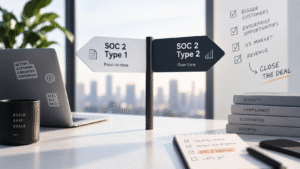
Type 1 Report
Early assurance milestone
Type 2 Report
Ultimate enterprise unlock
One report for customers in Toronto and New York
Licenses and certifications


How we help
Get your first SOC 2 right from the start
We guide first-time teams through every point where they tend to get stuck, then perform the examination and issue your report.
Clarity from day one
A clear view of what the audit requires, where you stand today, and a practical roadmap to your first report.
Evidence as you work
Evidence should come from the workflows you already run. We show you how to capture it along the way, so it doesn’t become a separate job.
Something to show buyers now
A signed initiation letter, an auditor in the room for security conversations, and a second check on your questionnaire answers.
SOC 2 Audit services
Type 1 and Type 2 Reports
We help you define the right SOC 2 path based on your timeline, budget, and customer commitments, whether that means starting with a Type 1 or going straight to Type 2.
Early assurance Milestone
SOC 2 Type 1 Report
An independent auditor’s opinion on whether your controls were suitably designed and implemented as of a specific date.
Best when
- A deal needs independent assurance now, and the buyer will accept a Type 1
- Your controls are newly implemented and you want to confirm design effectiveness
- You want an early security milestone that takes weeks instead of months
Timeline
4 to 6 weeks from request to report
Enterprise requirement
SOC 2 Type 2 Report
An independent auditor’s opinion on whether your controls were suitably designed and operated effectively throughout a defined period.
Best when
- Enterprise prospects require a Type 2 report before committing
- Your product handles sensitive customer data, such as financial or health records
- You have a Type 1 and buyers now want a track record of operating effectiveness
Timeline
6 to 9 month including reporting period
How we do it
Our SOC 2 process
Phase 01
01
Readiness Guidance
1
Gap assessment and roadmap
We compare your current policies, controls and processes against the scoped Trust Services Criteria, then give you a prioritized plan for closing any gaps.
2 to 4 weeks
2
Control design and implementation
Your team designs and implements the controls and drafts the system description, the part of the report that explains your service and how it’s controlled. We provide the roadmap, policy templates and examples to guide you.
4 to 12 weeks
3
Readiness assessment
Before your observation period starts, we review whether your controls are in place and consistently producing evidence. Issues can be addressed before they show up as exceptions in your report.
1 to 2 weeks
Phase 02
02
SOC 2 Audit & Attestation
4
Evidence gathering and testing
We request records from across the observation period, such as logs, screenshots and system settings, then test samples to check that each control operated the way your system description says it does. For example, was access removed on time when someone left?
2 to 4 weeks
5
Draft report and management response
We share a draft of the report with your team to review. If any issues were noted, you can add a response before it’s finalized.
2 to 4 weeks
6
Report issuance and ongoing support
The final report includes your system description, the controls tested and the results, and our opinion. It’s issued under Canadian (CSAE) and US (AICPA) standards, so one report serves buyers in both countries.
2 to 4 weeks
Independence
We never audit what we build.
Citadel Point does not design or implement the controls we audit. We assess where you are, tell you what is missing, and provide guidance and templates. Your team owns the build. That separation is what makes the opinion mean something to the customers relying on it.
Why work with us
A Canadian CPA firm built for SaaS teams
01
SaaS operating fluency
Our work starts from how lean, cloud-native teams actually operate. You won’t be handed enterprise templates to shrink, or spend hours explaining how your deploy pipeline works.
02
Built for cross-border deals
We work with Canadian companies whose growth runs through US procurement. We understand the deal pressure behind a first SOC 2 and plan the engagement around it.
03
Fits the stack you already run on
Already on a compliance platform like Vanta or Drata? We work inside it. If not, we’ll help you organize evidence in the tools your team already uses, and find what can be automated in systems like AWS and GitHub.
04
One audit, two standards
We report under both AICPA and CSAE standards, so one engagement produces a report your US and Canadian customers can both rely on. No second audit for the second market.
Deal support
Build buyer trust while your SOC 2 report is underway
Before your report is issued
- A signed auditor initiation letter confirming scope, report type and timeline
- An auditor in the room to speak to your engagement during key security conversations
- A second check on questionnaire answers, including what you can’t claim yet
- Controls your team understands well enough to explain to a buyer directly
Free guide
The first-timer’s guide to SOC 2
Citadel Point
Free guide
The first-timer’s guide to SOC 2
Inside
- 01 · What buyers actually mean when they ask for SOC 2
- 02 · Type 1 vs Type 2, and which one unblocks your deal
- 03 · Scoping without over-buying
A customer asked for your SOC 2. Start here.
A short call to understand where you are and what your customers are asking for. You’ll get a tailored proposal after.

You will be speaking to
Shane Troyer
Risk and Forensics Principal
SOC 2 FAQs
The questions we hear from first-timers
Yes. We issue both Type 1 and Type 2 reports. We recommend keeping the same scope across reports, so the Type 1 work carries forward into the Type 2. Many teams start with a Type 1 to support an active deal and continue straight into the Type 2 reporting period, which typically runs 3 or 6 months for your first report.
No. Small teams complete SOC 2 audits regularly. What matters is that your controls fit how you actually operate, so we interpret the criteria against your real structure rather than assuming functions you do not have.
It depends less on your stage than on demand. If a buyer is asking for a SOC 2 report, you are not too early. In industries where buyers expect SOC 2, such as healthcare or financial services, we recommend building the controls in from day one. Even if nobody has asked yet, scoping the work early is useful, because the foundation you set at the start shapes how long your first audit takes and what it costs.
Yes. The engagement is issued under both US (AICPA) and Canada (CSAE) assurance standards, so the same report satisfies domestic and cross-border customers.
Because you make every control decision and we never make it for you. We provide readiness guidance: templates, examples, requirements, and feedback on what you propose. You design, decide, and implement each control. Then we independently test what you built and issue the report. We advise and test; we never build. That line is what makes the report credible to your buyer.
No, you don’t need compliance software to get a SOC 2 report. While it can help organize documentation and automate parts of control monitoring and evidence collection, your team still has to run the controls. If you already use Vanta, Drata or similar, we work within it. If you don’t, we’ll show you how to set up a practical evidence gathering process in the tools you already use.
It depends on what your buyer is asking for and how fast the deal is moving. A Type 1 confirms your controls are designed correctly at a point in time and can move a deal quickly. A Type 2 shows they operated over a period and is what most enterprise buyers eventually expect. We will help you choose in the scoping conversation, and a Type 1 can lead into a Type 2 on the same scope.
The calendar runs for months, but the engineering effort doesn’t have to. It depends on three things: what’s already in place, such as SSO, MFA and code review; how many controls can run automatically in your cloud and CI/CD tools instead of manually; and how the work is shared, since policies, HR and vendor steps don’t need engineers. Most of the effort comes early, in closing gaps. Our prioritized remediation plan tells you where to start, so that effort goes to what matters most. We always scope to only what your customers require and build evidence requests around the tools you already use. You’ll know the scope and timeline before you start, so you can plan around your product roadmap.
Type 1 starts from $20,000 CAD and Type 2 from $30,000 CAD.
A Type 1 typically runs 4 to 6 weeks. A Type 2 depends on the observation period, usually 3 or 6 months for a first report, plus scoping, readiness, and fieldwork, so 6 to 9 months in total. We map realistic dates in scoping. The final Type 2 report is typically issued within 4 weeks following completion of audit fieldwork.
That is who this is built for. Your first SOC 2 is the one where early decisions matter most, and it is where independent audit judgment is most valuable, because getting scope and timing right at the start is what keeps the whole thing from ballooning.